

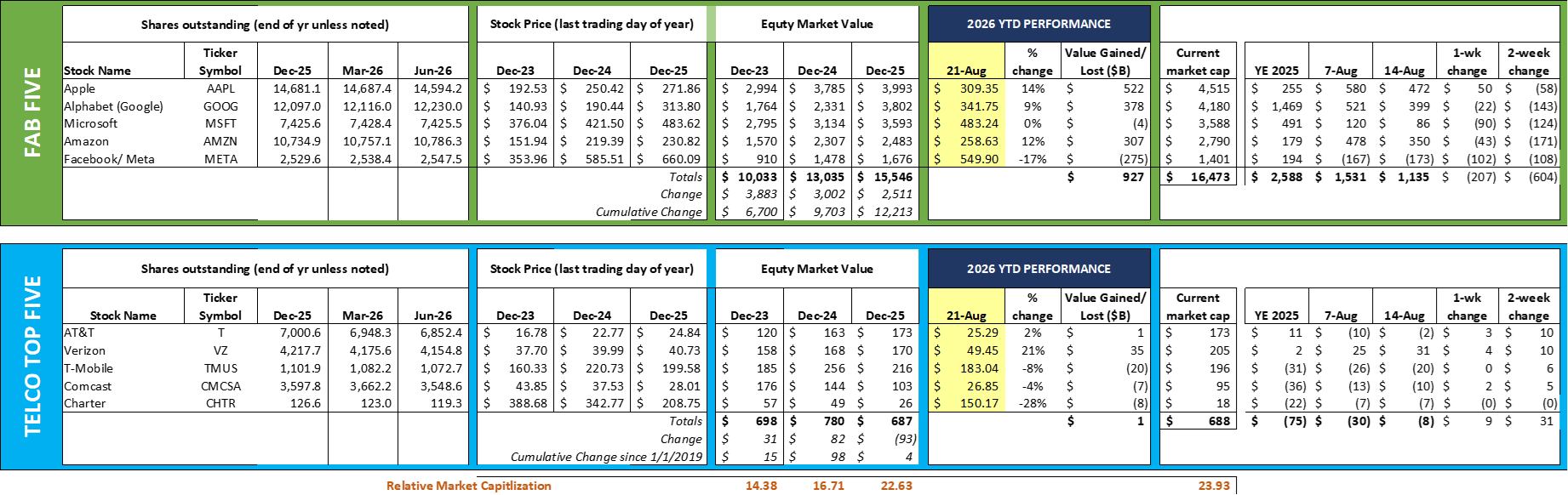
The middle of August ends a season commonly called the “dog days of summer” (here’s the article from The Old Farmer’s Almanac describing the seasonal event). From July 6 to Aug 14, the Fab Five gained $814 billion in value, while the Telco Top Five gained $62 billion, reaping investors a harvest of gains.
From now through late October (when free cash flow will once dominate valuation), we are left with interest rates, wars, and other economic data as the primary valuation drivers. Long-bond yields are the chief concern right now, peaking at 5.34% earlier in this week and settling at 5.28% as the Treasury department announced a bond buyback program. Whether the cash infusion provided by that action stimulates further inflation remains to be seen (great article from Bloomberg on Secretary Bessent’s strategy here).
Higher than expected interest rates have also impacted homeowners. Earnings reports from Home Depot and Lowe’s this week reinforced this fact. While on a year-over-year basis, Home Equity Line of Credit (HELOC) rates are down 0.5-1.4%, they are up 0.2-0.3% from the lows seen a few months ago. Consumer confidence remains low (see full details here), but retail spending continues to be resilient (data here).
After digesting all the data, the Federal Reserve Bank of Atlanta is currently estimating 4.0% real GDP growth (data here). This is down from the 5-6% level estimated a month ago (most of the decrease is attributable to lower residential investment estimates). Consumers are pulling back as the reality of high interest rates and energy prices are kicking in.
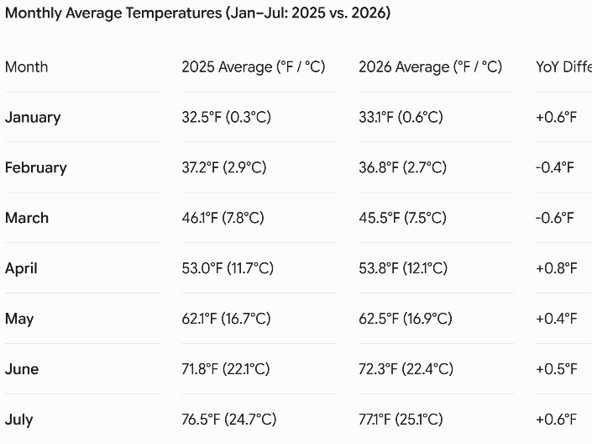
One energy segment appears to be less impacted by Middle East and Ukraine developments. Natural gas prices as of 8/21 are down 0.96% year-over-year (crude is up ~ 40% – data here). Areas of the US where natural gas is more commonly used for heating and cooling will disproportionately benefit (states like Florida, Texas, and Louisiana are also highly dependent on gas-powered generation for electricity). Average temperatures moderated in May, June and July as the nearby chart shows.
One final note: The Bureau of Labor Statistics issued their July changes in employment and unemployment by state (only one state – Maryland – had a statistically meaningful employment increase while New Jersey was the only state with a material employment decrease). Here is the leaderboard for top employment changes in the past twelve months (full report here):
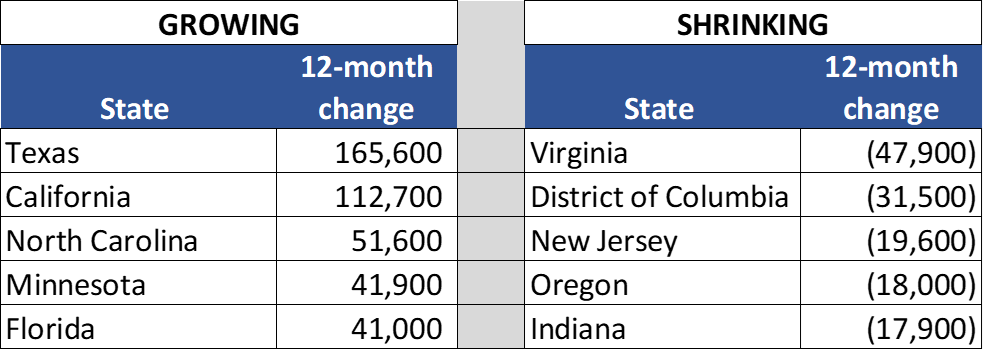
It’s interesting to see who is not on the list as much as who made it. Maryland has bounced back with a mere 600 job loss over the last 12 months. Illinois, long regarded as a blue state has added 12K jobs over the last year. Minnesota, a state known for its high taxes and cost of living, has added 42K jobs in the past 12 months.
Florida, who has had a string of employment gains over the last decade, now employs more people than New York state. Here is a chart showing where changes came from (data here):
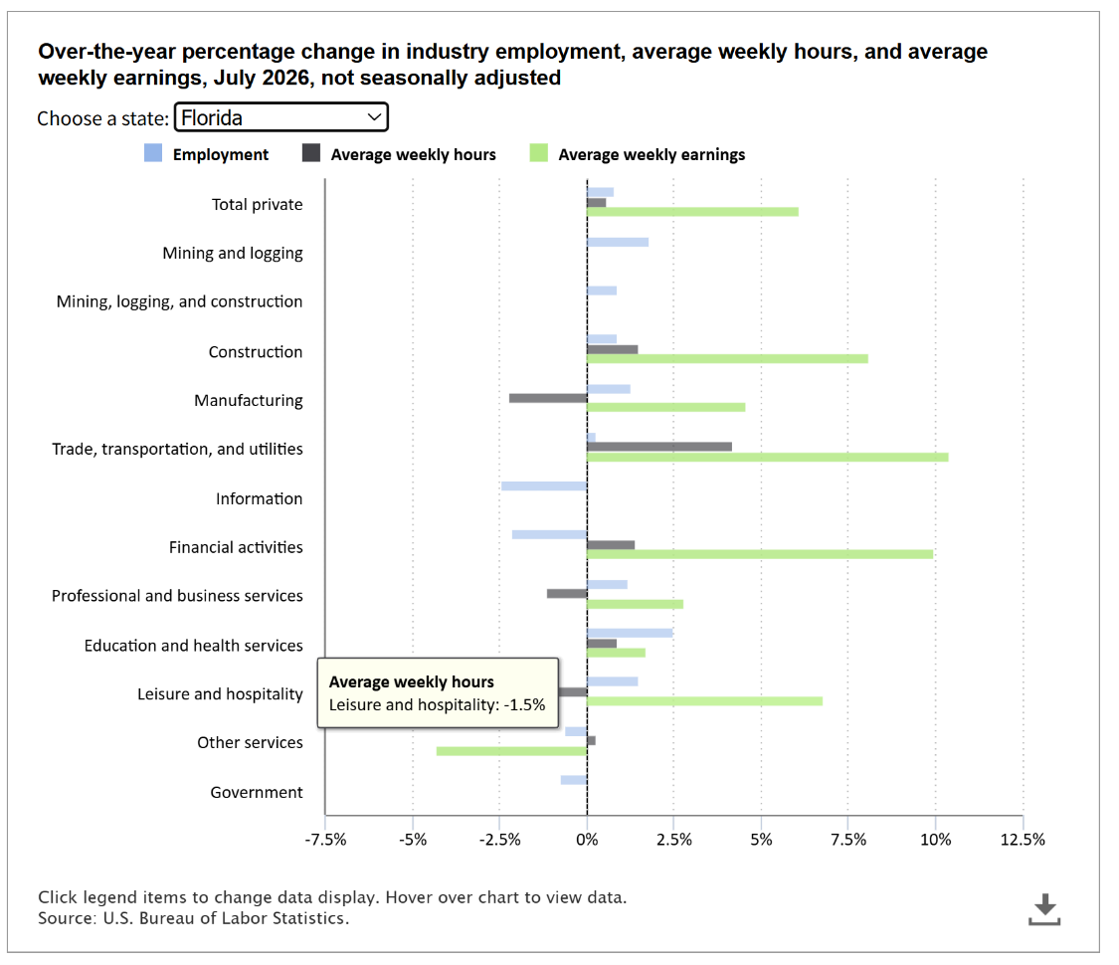
We find this state data to be particularly interesting. Many states are experiencing employment growth in construction, and in every instance we analyzed, the growth in average weekly earnings (green bar) was meaningfully large (in the case of Florida shown above, the wage growth rate is 7.8%). As multiple months are tallied, we are going to solidify that the recovery is well underway in the trades, while those who are employed in professional services are seeing lower wage growth than underlying inflation. We think this explains a lot about the general mood of the population – it’s a “K shape” but the segmentation is between hourly trades and salaried professionals.
Data is below. Have a terrific week!
