

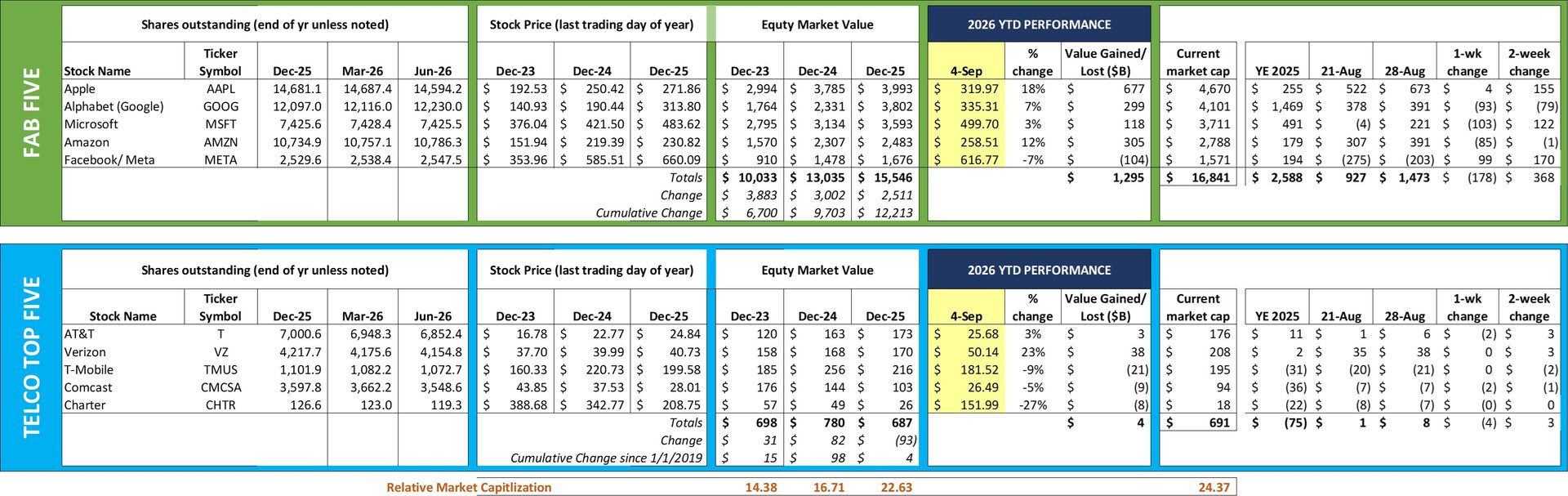
This was a relatively quiet week for the ten stocks we track with the Fab Five down a modest $178 billion (led by small declines in Microsoft, Google/Alphabet, and Amazon) while the Telco Top Five was down $4 billion. The big mover this week was Meta — expected, as it’s the only Fab Five stock that is down in 2026. Meanwhile, Verizon continues to hold on to recent gains and leads the Telco Top Five market cap by $13 billion (T-Mobile is second).
This was a week where the headlines were dominated by CFO changes. Charter announced that current CFO Jessica Fischer will be leaving on October 15th to “relocate for another opportunity” (announcement here). Judging from the news release, this seems to have come as a bit of a surprise. Scott Beasley, who was CFO for Frontier Communications under Nick Jeffrey, seems like a logical pick (re: Nick started as COO of Charter on September 1), but is already the CFO of Vantage Data Centers. CEO Chris Winfrey was Charter’s CFO until 2021 and definitely has an idea of what’s to come. We do not think Perley McBride (former Cox Communications CFO) is going to leave his new role as CFO of Cox Enterprises for Stamford. Many choices from within the company exist, and it’s a critical role as Charter communicates synergies from the Cox transaction to shareholders.
Not to be outdone, T-Mobile announced that Peter Osvaldik will be leaving the company as part of an orderly transition next February (announcmeent here). Jessica Uhl, who is the former CEO of GE Vernova, will succeed Peter. Based on 2022 proxy information, Peter is 52 years old. Continued references to “retirement” in the news release are far-fetched. If we are incorrect, however, best wishes to you, Peter, in your retirement. If our hunch is correct, we have some ideas for you both on the VC/PE and the individual company side.
Finally, there was a jobs report on Friday that no one really believed because the revisions and current readings were too robust (link here). Some commentary is needed. Here’s what we know from earnings reports and corresponding economic data:
- Wage growth in the trades is increasing faster than inflation (it’s a great time to be an electrician in the Midwest)
- Those wages are translating into increased consumer spending which leads to increases in inventory and eventually into jobs (see the revisions to the Atlanta Fed GDP now estimate here – current real 3Q GDP estimate is 4.7%)
- As the table shows below, in many (but not all) occupations, both employed AND unemployed people are falling (meaning more folks are retiring or leaving the workforce for various reasons than are entering). The data from the table (A-13) is taken from the Household Survey which is used to derive the unemployment rate:
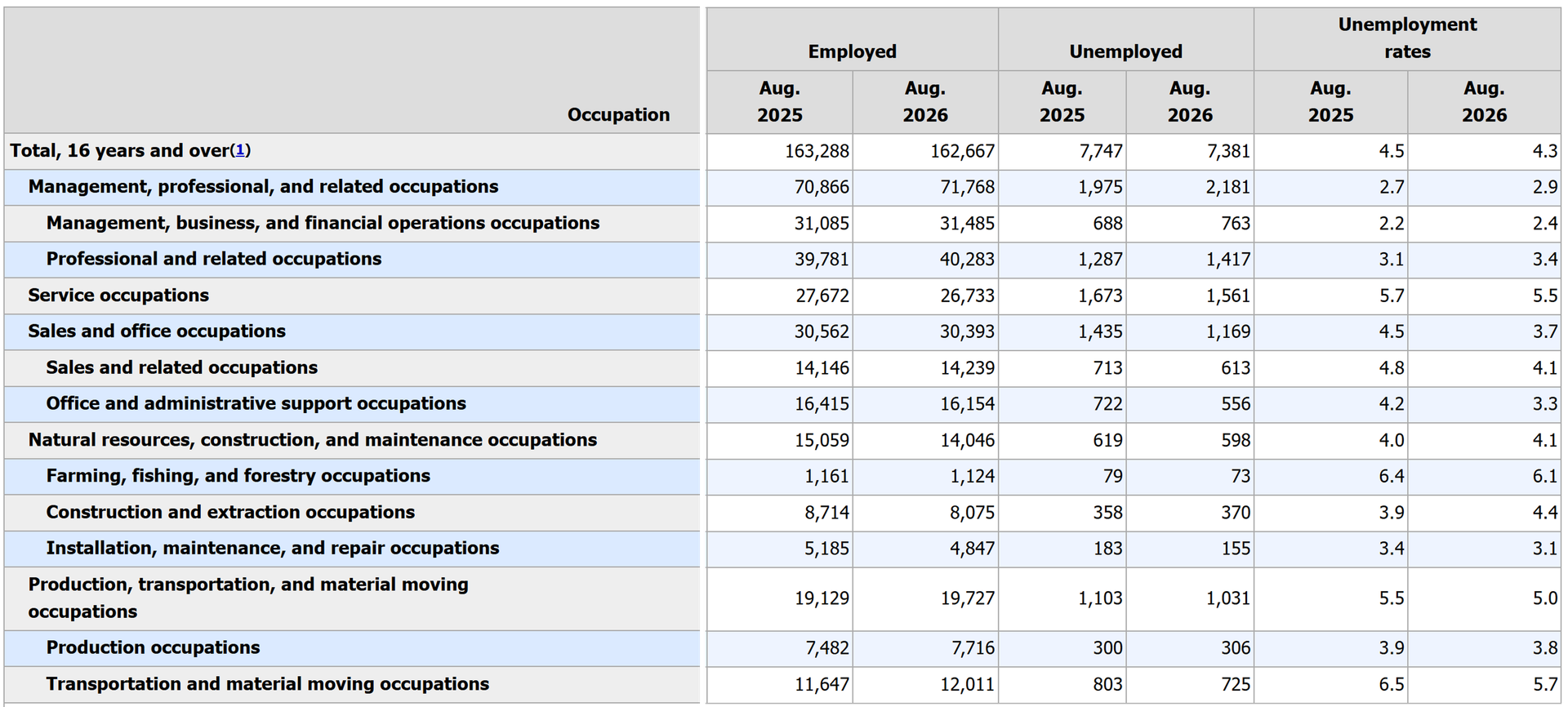
In our opinion, the focus should be on productivity improvements required to generate a 3.0% or higher real GDP growth. Perhaps wage growth is the persistent inflationary factor that holds up inflation for the next five years (and cross reference this with Table A-7 in the report which shows that non-native population losses are starting to level off). Lots of good data here, but no new answers to the problem of growth.
Data block is attached below. Have a terrific remainder of your Labor Day weekend!
