


August greetings from Kansas City, Cedar Rapids and the Outer Banks of North Carolina, where our family gathering (22 of us) concluded our vacation last Sunday. Lots of beach activities with perfect weather and minimal sunburns – can’t wait until next year!
This week’s Brief continues our earnings and strategic positioning analysis for each of the Telco Top Five. AT&T, the most undervalued stock of the Telco Top Five, is this week’s focus. We will scrutinize Ma Bell’s “to do” list and strategy. Prior to that, let’s look at valuation changes and other news events in the world of telecom.
The Fortnight That Was
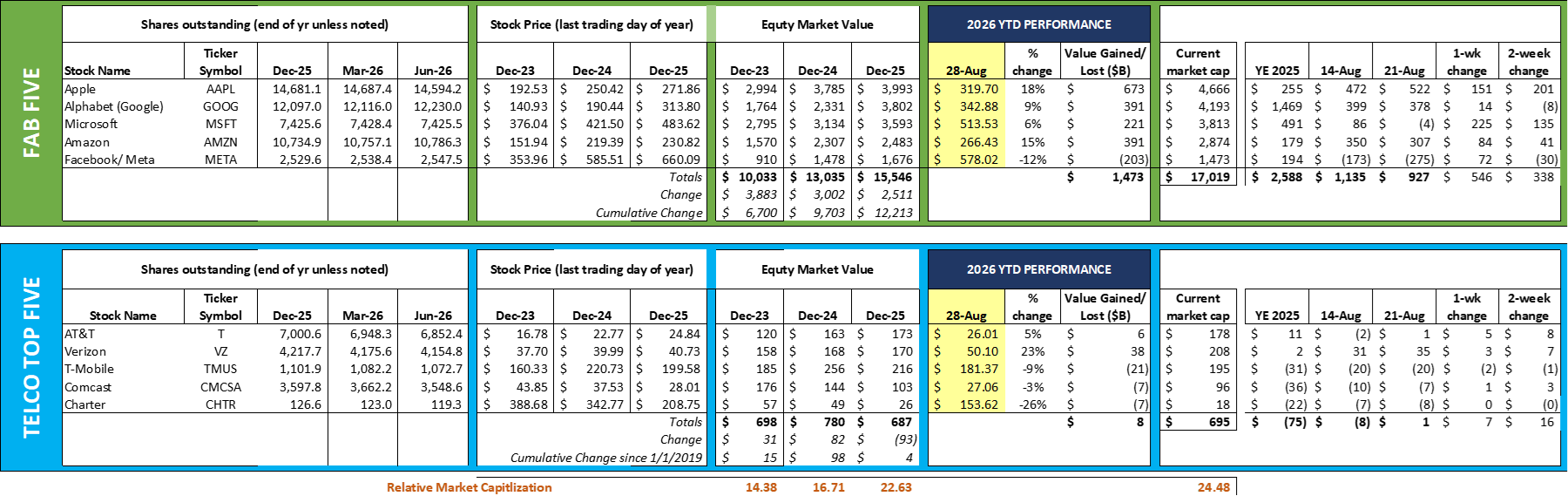
In the last full Brief, we posited “Could the Fab Five hold on to their late July gains?” At that time, they were up $1.14 trillion for 2026. Over the last two weeks, that figure has grown to $1.47 trillion. And, as noted in the previous Brief, a disproportionate portion of Fab Five gains came from Microsoft (+$135 billion in the last two weeks and up $365 billion since the end of July). The only stock in the Fab Five that has lost value so far in 2026 is Meta, and they are up $170 billion from their March lows.
Investors who are looking for stable cash flows and decent yields are increasingly turning their gaze to telecom, specifically Verizon (5.7% dividend yield even with 2026 price appreciation), Comcast (5.0%), and AT&T (4.4%). If Verizon maintains their current stock price, the annual return to shareholders will be ~ 30%, a figure greater than that experienced during the 7.2 years of the previous CEO’s (Hans Vestberg) reign. As we discussed in our earnings analysis a month ago, Verizon may not sustain the current trajectory, but they are certainly not going back to the past malaise that permeated the culture under previous leadership.
Meanwhile, T-Mobile continues to melt. So far in 2026, there has been a $59 billion value shift between Big Red (+$38 billion) and Magenta (-$21 billion). While they closed on the sale of 800 MHz spectrum to Grain Capital this month (August 11 for $2.9 billion in net proceeds – see announcement here), investors are less enthusiastic about how the company will invest this excess cash to multiply returns. We think there are plenty of opportunities to reinvest in the sector; share buybacks may not produce the long-term stock price gains that frequently are used to justify those activities (just ask Charter who is holding $70 billion+ of stock buybacks at $430/ share).
As of Friday’s market close, there is a $13 billion gap between Verizon and T-Mobile, and a $30 billion gap between Verizon and AT&T. Our prediction is that the gap between AT&T and T-Mobile will continue to shrink through the end of 2026. Entering 2025 (20 months ago), T-Mobile held an $88 billion advantage over Verizon and a $93 billion advantage over AT&T. The fiber+wireless convergence story is slowly winning over investors’ minds, even though T-Mobile’s wireless account additions continue to impress. All three have a better story to tell than cable, but that may not last long as DOCSIS 4.0 rollouts reach critical population centers.
There has also been a considerable amount of macroeconomic data released in the last two weeks. Here are the theses we began to develop in the spring and early summer (mostly validated by the recent reports):
- Income growth is favoring the second and third lowest quintiles. This income growth is stimulating meaningful consumer spending. All quintiles are experiencing income growth, but the fastest percentage growth is in the middle classes.
- Wage growth for selected occupations (construction, farming/mining/fishing, transportation) are outpacing management and service gains. See Table 4 in this Bureau of Labor Statistics July release – construction occupations wage growth was 8.6% from 2Q 2025 to 2Q 2026, farming and fishing up 9.1%, and transportation/ logistics up 4.4% over the same period. This compares to a 3.3% increase for management occupations and a 1.5% increase for office occupations. Thanks to AI spending, wages are rising far more than inflation for trade workers.
- Real wage growth is stronger in the Southern and Western parts of the United States (excluding the West Coast). More jobs/ hours, higher wages, and lower costs of living favor some parts versus others. There are exceptions (Ohio, Pennsylvania), but the West Coast and New England are trailing the Midwest and Southeast. Arizona State’s Seidman Institute has some terrific charts showing fastest growth (number and percentage) here. The Southeast still has Georgia, and New England still has Connecticut, but the thesis nevertheless holds. Here’s the PCE tracker by state as well (although slightly dated).
- Interest rates will not decrease until there is lower real GDP growth. Because of the factors described above (and despite the damper placed on the economy by Federal government shutdowns and armed conflict), the economy is continuing to grow at a 2-3% annual rate. Here is the GDP chart for the last twelve quarters through 2Q 2026:
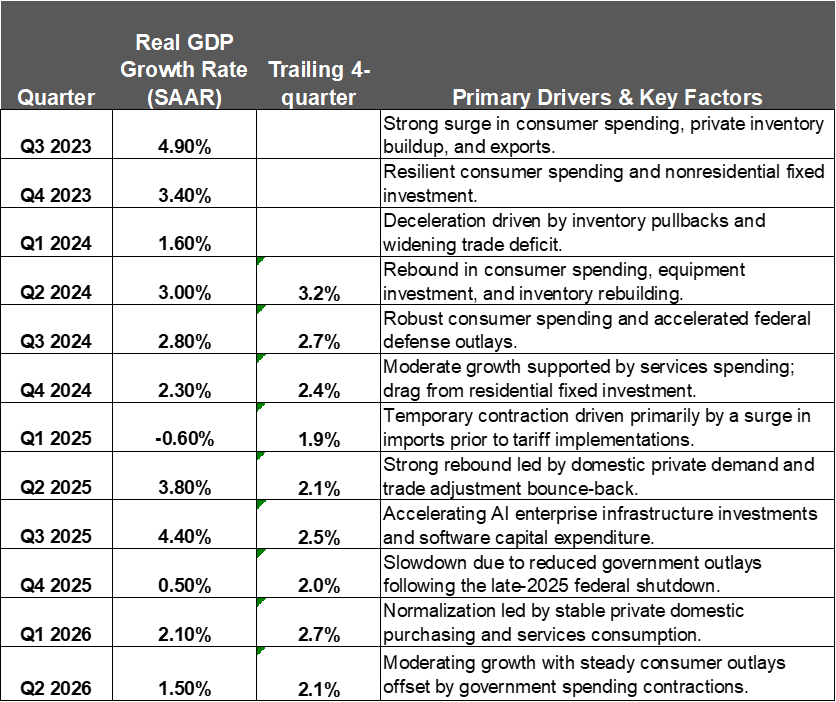
As we noted last week and will continue to monitor, thanks to inventory buildups and increased business and personal investment, the Atlanta Fed currently expects the economy to grow 4.6% in the third quarter. If this estimate materializes, it will be the fastest quarterly growth in three years (and average growth using the previous four quarters will be at 2.2%, which is similar to what it was for much of 2025). With that level of growth (along with hundreds of billions in fresh AI investment each quarter, and continued Federal budget deficits), it’s unlikely we will see interest rates drop anytime soon.
This data is positive for the telecom industry. We will discuss the specific impact of regional growth to AT&T below, but as fiber affordability increases for the middle classes, disposable income allows iPhone price increases to be absorbed without disrupting upgrade rates, and credit scores/ quality grows as savings grow/ credit card debt slows. Job losses related to Federal government employment are the only material headwind, and that impact is regional (see last week’s interim Brief for the specific impact on Maryland and Virginia employment levels).
2Q Earnings Review – Franchise Value
Before Tesla/ SpaceX, there was AT&T, and specifically Bell Labs. This organization launched the first solar-powered satellite, invented the transistor, the laser and photovoltaic cells, developed the UNIX operating system, and generated over 30,000 patents over the last 100 years. Without Bell Labs, we would not be developing plans for data centers in space. Bell Labs (along with IBM) worked closely with the Federal government to develop systems that brought about the end of World War II and the Cold War. It was one of the national treasures of the 20th century and embodied the brand of AT&T. A great read on Bell Labs’ impact on American society is John Gertner’s The Idea Factory, available here on Alibris.
Then came the breakup (see our 2019 Brief on that here – we also highly recommend Steve Coll’s book on the topic here) which resulted in the divestiture of local telephone exchanges (also called franchises). This was followed by company diversification (NCR, Lucent, TCI – all of which were divested) and densification (McCaw Cellular, Teleport Communications Group). This was followed by AT&T’s acquisition by SBC Corporation for $16 billion in 2006 (2005 article from The New York Times here).
From the time AT&T was acquired by SBC until 2020, the company was run by former SBC executives (Ed Whitacre and Randall Stephenson). The internal mantra was “above all else, protect franchise value.” They consolidated wireless to form Cingular, then bought BellSouth – all in the name of creating higher barriers to competition (which were real – wireless substitution and cable’s entry into local phone service pushed AT&T back up the cost curve as they lost market share). Consumer and shareholder value would be added through applications and services (DirecTV, WarnerMedia) with a slow and managed evolution from Digital Subscriber Line (DSL) to Fiber to the Home (FTTH) technology.
Then John Stankey became CEO. Like Ed and Randall, he was raised in the Southwestern Bell system and fully understood the value of a strong and robust local exchange franchise. John also has a keen understanding of systems and operations from his roles as AT&T’s Chief Information Officer and the head of AT&T Business Solutions. After tens of billions of writedowns and shareholder value destroyed, it was his turn to lead.
The 2Q 2026 earnings report reflects the fruit of that strategy. Stop the vertical integration (spun out WarnerMedia, sold DirecTV to private equity) and focus on fiber expansion. Use acquisitions (Echostar spectrum, Lumen) to selectively expand and improve franchise value. Increase communications “share of wallet” for every household, but especially those in the local franchise. Most importantly, have a bias toward building (and expanding) vs. buying.
The results of that strategy are seen in their current operating metrics:
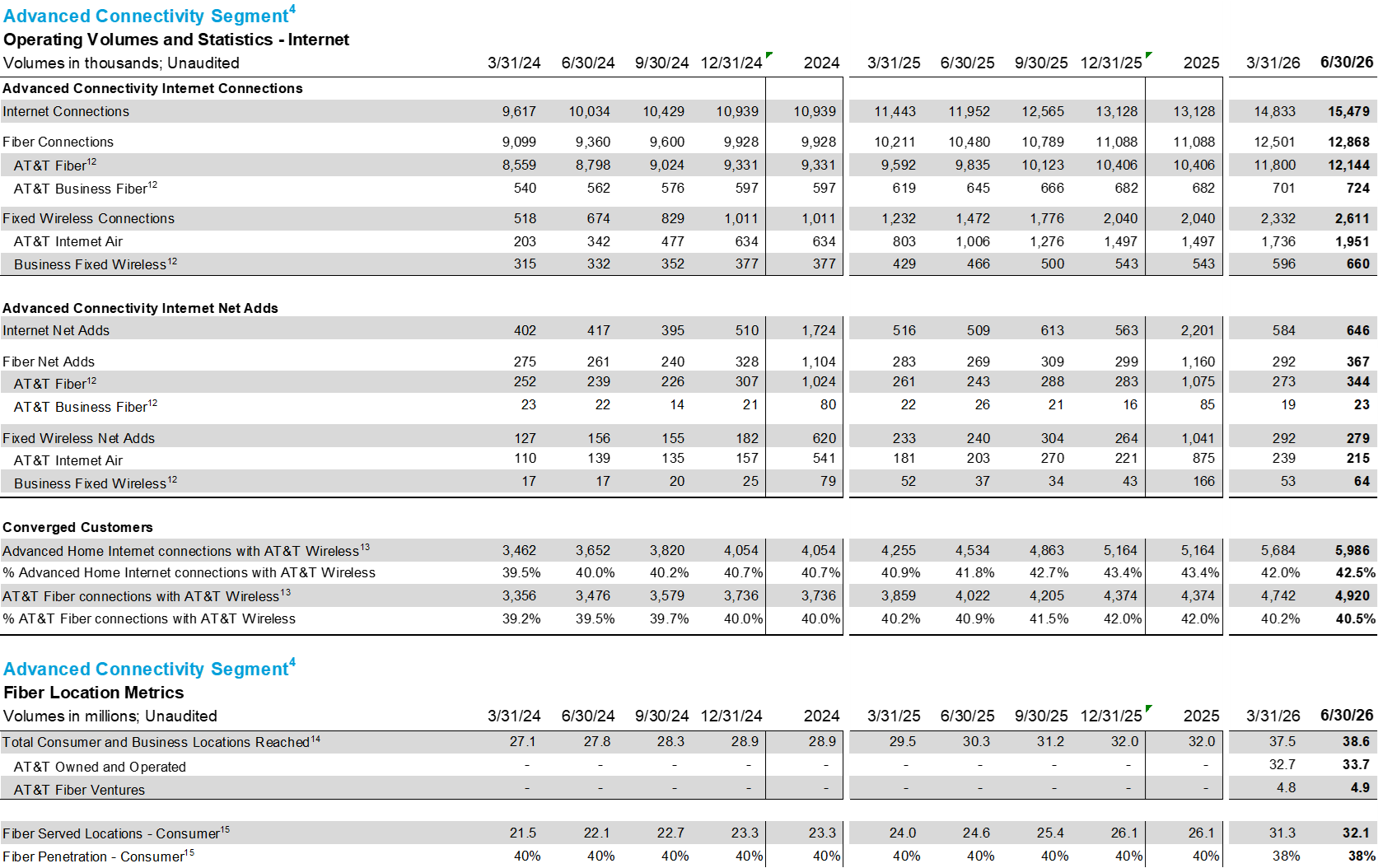
AT&T expanded their consumer fiber reach by more than 10.6 million locations since the beginning of 2024. About 60% of that figure comes from upgrading existing copper plant to fiber (the remainder from acquiring Lucent’s fiber operations). Separately, AT&T has taken advantage of fallow wireless capacity to focus on replacing third-party (out of franchise) access spending with Business Fixed Wireless services.
And profitability is rising even as they continue to upgrade their plant. The company’s consumer Advanced Connectivity segment generated $10.1 billion in EBITDA (45.2% margin) in the quarter even with increased Lumen spending. Their legacy markets (24 months after 80%+ of the market is served by fiber) is likely generating 50%+ EBITDA margins. And many of those markets, especially in Texas and Florida, are some of the fastest growing populations in the country.
In the second quarter, the construction progress finally started to benefit the business segment. Here are their quarterly earnings trends:
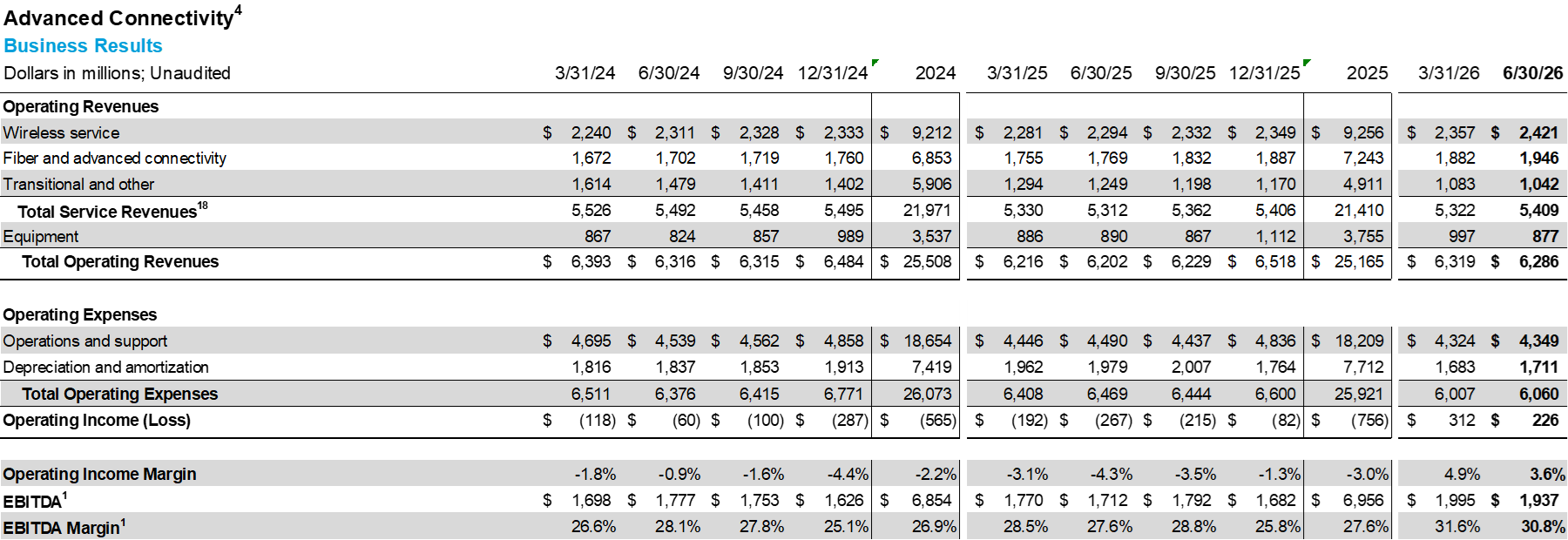
The business segment (which has significant presence outside of the franchise properties) is a smaller drag on operating profits. AT&T Business highlights can now include something other than their FirstNet rollout success. It’s premature to declare mission accomplished, but they are out of the ICU (Intensive Care Unit).
Despite the successes, AT&T’s stock price has trailed their peers and the S&P index. Before dividends, the stock is up 26.3% over the last five years compared to 71.2% for the S&P and 31.0% for T-Mobile (note: most of T-Mobile’s gains came in the early part of 2021 as the Sprint merger synergies were realized; Verizon’s stock, even with recent gains, is down 8.5% over the last five years – link to Yahoo! Finance chart here). When will the company reap the harvest of their tens of billions of capital investment?
Our view is that they need to reach four milestones:
- Clear demonstration of the 50% penetration + 50% EBITDA threshold for multiple large AT&T Fiber markets;
- Acquisition/ retention/ account/ customer lifetime value metrics which clearly demonstrate the value of the Lumen fiber markets acquisition;
- Execution of a business strategy that provides secure work-from-home (WFH) connections for business applications (not bundle discounts but valuable product enhancements that create a home extension for businesses);
- Debt reduction levels that result in coverage ratios that are (near) best-in-industry.
Bottom line: AT&T is pursuing a local franchise strategy that maximizes value for 60 million homes (40% of the country). These homes are in some of the fastest growing areas of the country (Florida, Texas, Arizona (Lumen), and the Carolinas). In addition to readying 20 million additional homes for fiber, they are transforming fiber coverage for their wireless and enterprise network customers. They are moving slower than many expect but are beginning to see the cash flow impacts of a consistent, ubiquitous strategy. Within two years, AT&T could emerge with a higher market cap than Verizon or T-Mobile, but there are risks.
We will conclude our 2Q earnings analysis (and strategy development) with Comcast and Charter. In the meantime, if you have friends who are interested in being notified each time we publish a Brief, please have them sign up at www.sundaybrief.com.
Go Royals and Sporting KC!
Important disclosure: The opinions expressed in The Sunday Brief are those of Jim Patterson and Patterson Advisory Group, LLC, and do not reflect those of CellSite Solutions, LLC, or Fort Point Capital.
