


July greetings from Kansas City, Cedar Rapids, and St Louis, where we enjoyed a Major League Soccer match in Saint Louis with several members of the LB Networks management team. Over two terrific days in the Gateway City we spent time with four telecom/infrastructure CEOs discussing the industry and mini data centers.
This week’s Brief encapsulates each Telco Top Five company’s earnings theme in one word: Lumen (AT&T), churn (Verizon), succession (T-Mobile), and consolidation (cable). Many sub-headers lie behind these themes but, after digesting many executive interviews driving between Kansas City and Cedar Rapids, these areas are clearly on the minds of their C suites.
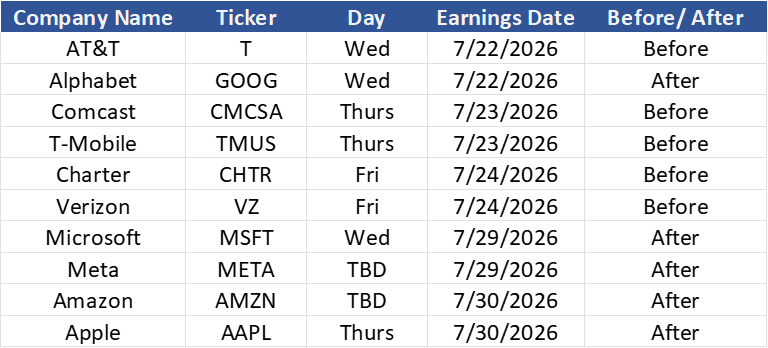
The most recent 2Q earnings schedule is shown nearby. Next week is mostly the Telco Top Five followed the week of the 27th by the Fab Five. We should have plenty of company news to discuss in two weeks (and throughout August).
The Fortnight That Was
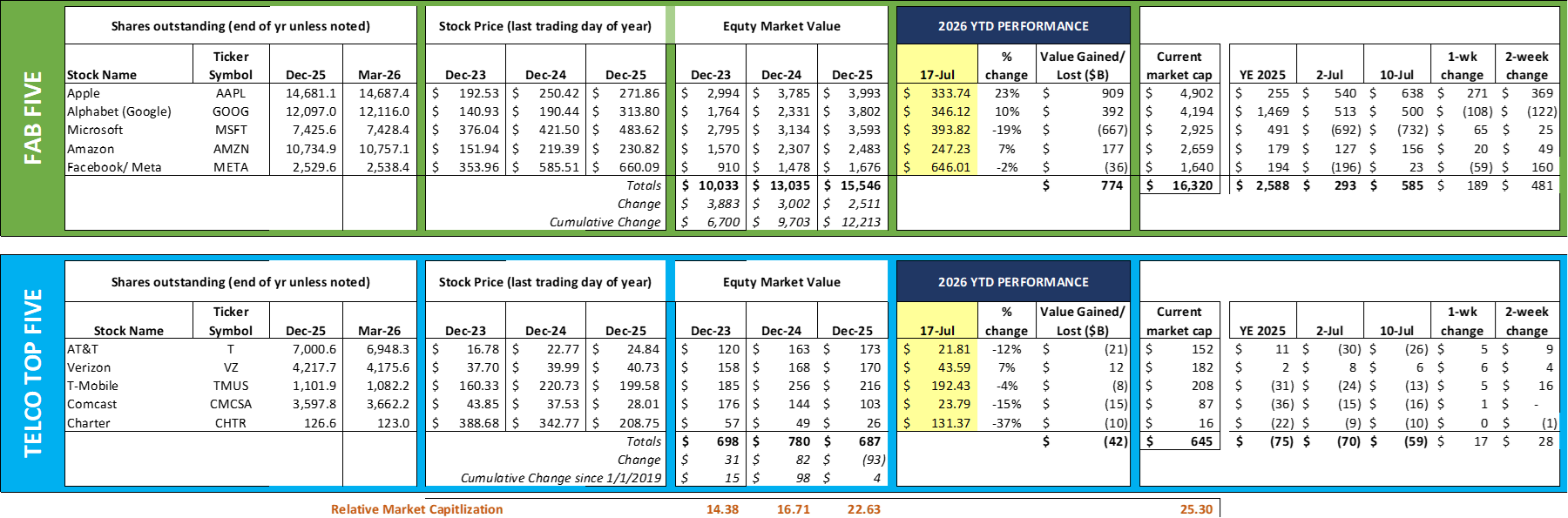
The last fortnight has been strong for both the Fab Five (+$481 billion) and the Telco Top Five (+$28 billion). The Fab Five are on track to add $1-1.5 trillion dollars in market capitalization (ending with a cumulative value of $17 trillion) in 2026 while the Telco Top Five will struggle to break even (ending with a cumulative value of $600-650 billion). The comparison between the two groups a decade ago was valuable – today, it’s irrelevant. But for wireless and residential internet, the telecom investment value thesis has shifted from connectivity to intelligence, and the smart money has moved to the Fab Five.
A comparison of the balance sheets (particularly the net debt) shows why the Fab Five are in a much different position than their telco brethren. AT&T, including tower operating leases, announced $145 billion in net debt as of March. Verizon has $164 billion, Charter has $94 billion, Comcast has $85 billion and T-Mobile has $86 billion. Here’s how that compares to the Fab Five balance sheets (as of Q1):
There is a $770 billion difference between the negative net debt of the Fab Five and the $573 billion of net indebtedness accumulated by the Telco Top Five. While this gap will narrow after 2Q earnings are posted, we project there will still be $600-650 billion of “debt gap” headed into the end of 2026 between the two groups (and tens of billions per quarter in cash flows from operations favorability for the Fab Five). We have discussed the calculated and deliberate “risk on” mentality of most of the Fab Five with respect to AI infrastructure investment and think that any additional liability increases should be evaluated against their telecom peers. The Fab Five are both a smarter and a safer bet.
The macroeconomic picture, even with the Iran war intensifying, looks very good. With earnings just posting (exception being IBM), company outlooks are increasing, not decreasing. As everyone predicted, energy prices are very volatile, and the Middle East is rallying to bypass the Strait of Hormuz (this Saturday article from The Wall Street Journal on U.A.E and Saudi efforts to transport via trucks and rail was particularly informative).
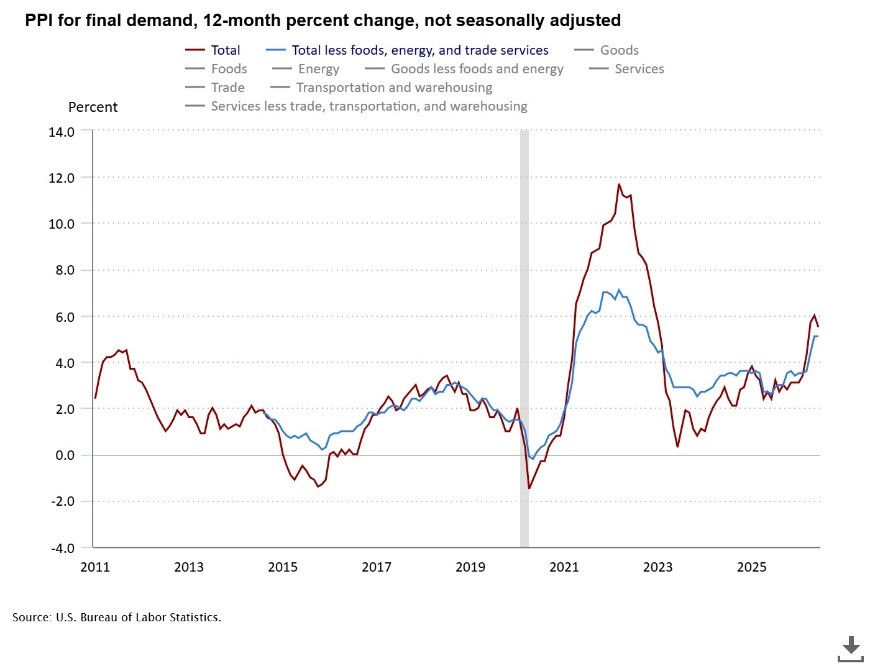
Producer prices continue to be stubbornly high as the nearby chart shows. Even when excluding food and energy (blue line), they are rising at a 5.1% annual rate. While lower than in the post-pandemic years, a 5% inflation rate is not conducive to low interest rates and job creation. The war cannot end soon enough.
High costs of energy impact operating margins at Fab Five and Telco Top Five companies. The twelve-month change in energy costs (PPI) as of June was 23%. It was -0.4% as late as this past February. Even with efforts to improve energy utilization, that level of cost increase cannot be easily absorbed.
Retail spending figures were also released this week (link to data here) and they continue to show remarkable growth (+0.7% month/ month and +6.7% year/year excluding gas). This led the Atlanta Fed to increase their 2Q GDP growth estimate to 1.7% (from 1.3%). We think that this estimate will continue to rise as the economic impact of the World Cup and energy exports are better understood.
On the personnel front, Zayo Group announced this week (here) that former Verizon executive Sowmyanarayan Sampath will join the company as CEO on September 1st. We think this is a good move for Zayo as they continue to absorb the Crown Castle fiber assets (transaction closed May 1). Separately, T-Mobile announced that Mike Katz would be leaving the company in the fall and replaced by Chris Sambar at AT&T. As we discuss below, there have been many changes at T-Mobile over the last twelve months. While the company has been able to keep its focus, Mike’s departure will have an impact. We wish Chris and Sampath the best as they transition to their new responsibilities.
2Q Earnings Preview – Five Companies in Four Words
Second quarter earnings start in earnest this week, and each company will be emphasizing one or two themes in their announcements. While each company’s “word” warrants its own Brief, we summarize it in less than a thousand words below.
AT&T: Lumen. Normally we would select AT&T’s convergence metric (which will show steady growth) but the surprise on Wednesday will be how quickly the company has integrated Lumen (Quantum) into their AT&T Fiber operation (this also shows how cash strapped Lumen has been for the last five years). Here is the data as of Q1 for consumer fiber and fixed wireless:
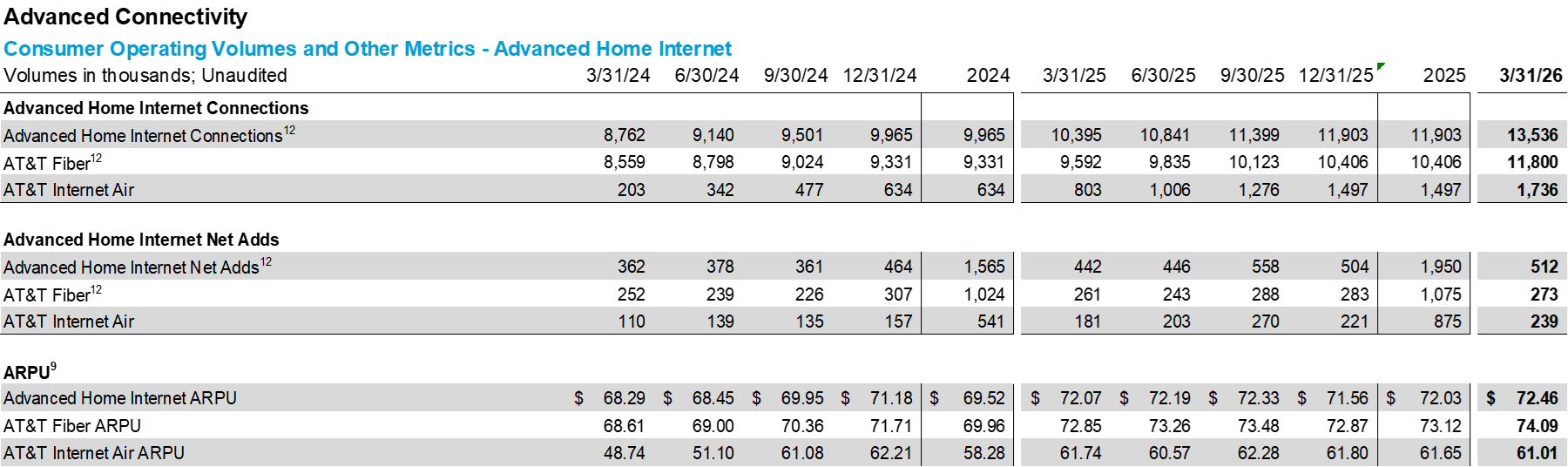
Per AT&T’s Q1 earnings presentation, Lumen dragged down AT&T’s overall convergence metric to 42% (excluding Lumen, the metric was 45%). As a reminder, the convergence KPI is the percentage of AT&T Fiber subscribers who are also AT&T wireless customers. The legacy Lumen asset had only reached 27% penetration (defined as customers as a percentage of homes passed). And Q1 earnings only reflected two months of Lumen’s Mass Markets EBITDA.
Here’s what we think AT&T will say:
- Lumen revenue and cost synergies are exceeding plan
- It’s still going to take time to get Lumen fully absorbed into AT&T, but that transition is exceeding expectations
- Lumen buildout is accelerating
- The pre-Lumen and current convergence gaps are narrowing
- AT&T’s store network and marketing scale are the reasons for this growth
We think that AT&T will impress on residential and underwhelm everywhere else. They are clearly focused on reaching the 60 million homes passed with fiber KPI and are slowly growing their converged offerings. While we still believe that they should be growing even faster in some of their (Texas, Florida, Georgia) markets, we think that the West (Lumen) will show the greatest change.
Verizon: Churn
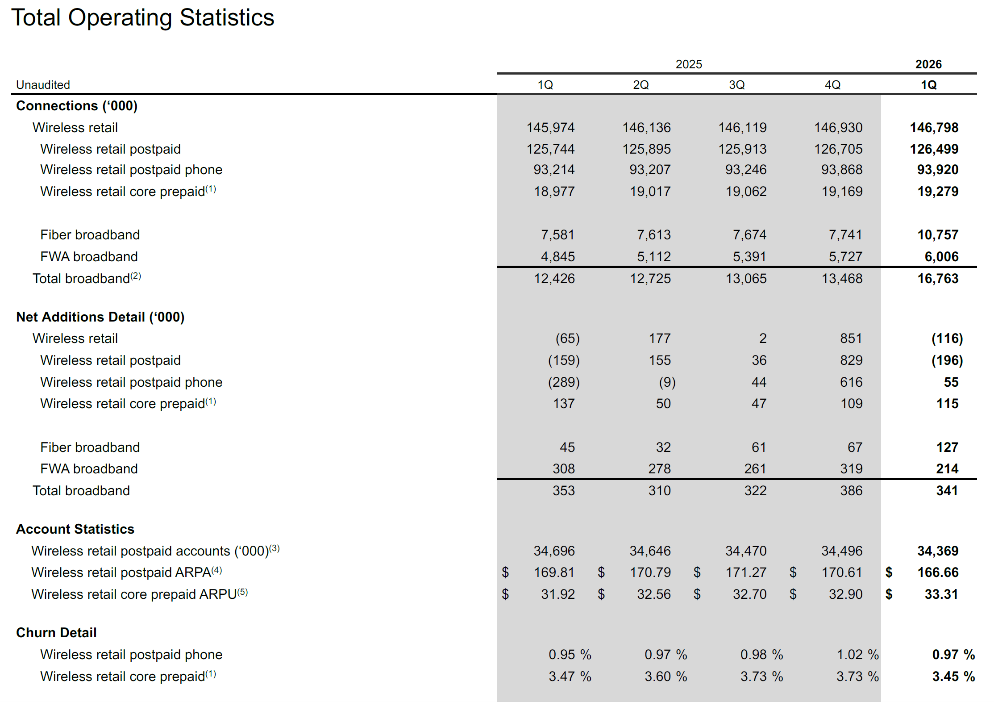
We have listened to or read more than a half dozen interviews with Verizon’s CEO (Dan Schulman), and are convinced that churn, and the underlying reasons, have been elevated to a “Top 3” metric at the company. We do not think this is confined to postpaid phone churn either – prepaid phone, fixed wireless, and tablet/ watch/ accessory churn is also being scrutinized.
Nearby are the churn metrics through Q1 2026. Wireless retail postpaid phone churn was slightly higher than Q1 2026 (re: Verizon had an outage in January that could have impacted postpaid churn). Every 0.01% (0.0001 * 93.9 million customers) of monthly churn translates into 28K quarterly retail postpaid phone additions.
Churn is always a priority. Elevating it to the top was a clear change when Dan Schulman took the helm last October. Behind churn are a host of operating metrics: dropped calls, weak calling signal, calls to care (and resolution), billing vs. network issues, and many more. Verizon’s network performance has masked a lot of “doing business with the company” issues. With T-Mobile’s network performance improving across metro and rural areas, the standard has been raised.
We don’t know the full extent of Verizon’s customer experience changes beyond plans like Verizon One, but thinkthat one is worth mentioning. Jeff Moore, the CEO of Wave7 Research, has a terrific presence on X (would recommend both their research and following Jeff on Twitter) and posted earlier this month that Verizon was doing away with IVRs at company-owned stores. When customers have issues, they can directly reach someone in the store for help. This is a low effort, high impact change at Big Red – they need a lot more to meaningfully move the needle.
Our prediction is that the monthly postpaid phone churn moved down 0.04% and as a result saved the company around 110K postpaid phone net adds. Combined with accelerated efforts to market wireless to Frontier fiber customers (helping gross adds), we think Verizon could post postpaid net adds above 190K, which would be their fourth straight month of positive net additions. This also leaves room for further improvement efforts in advance of the September iPhone upgrade/ selling cycle.
Churn is not confined to postpaid phones, however. Low fiber churn will indicate that they are not trying to rush the Frontier integration into Verizon. This figure is not typically published, but we don’t think voluntary Fios churn is very high. Also, keeping prepaid churn below 3.5% will be critical.
T-Mobile: Succession. We expect T-Mobile will be the Big 3 winner with strong postpaid, prepaid, fixed wireless and (hopefully they will disclose) business account growth in the quarter. This continuity is important given the significant transitions that have occurred within Magenta over the past year. Here is a picture of the executive team from the July 2024 earnings call:
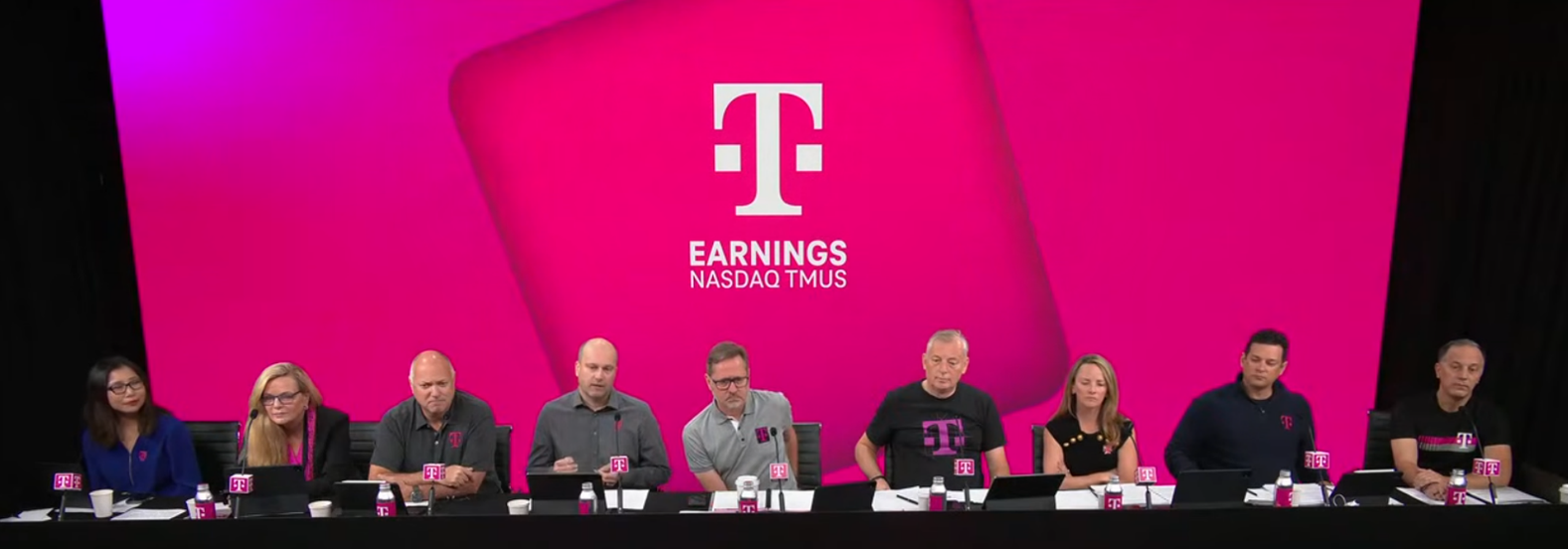
Of these nine executives pictured, only four are in their current roles:
- Mike Sievert, CEO in July 2024, has been replaced by Srini Gopalan (Mike is now Vice Chairman);
- Ulf Ewaldsson, President of Technology (to the right of Mike in the pic), has retired and been replaced by long-standing Clearwire/Sprint/ T-Mobile executive John Saw. Neville Ray served in Ulf’s role until the 3Q 2023;
- Callie Field (to the right of Ulf in the pic), head of T-Mobile for Business, left in December 2025 and will be replaced by Chris Sambar;
- Mike Katz (to the right of Callie in the pic), who has worn many hats in the company, will leave in 2026 and be replaced in part by Chris Sambar and Andre Almeida (see announcement link above);
- Janice Kapner (second from left in the picture), head of Communications for many years at the company, still serves as an advisor to the company but left her previous role at the end of 2025. She was replaced by Lucy McLellan
It’s important to note that Jon Freier is still at the company and was elevated to Chief Operating Officer last December, a well-deserved promotion. That leaves the Peter Osvaldik (CFO), Cathy Yao (SVP – Investor Relations) and Ankur Kapoor (Chief Network Officer) as the remaining “in place” executives in this picture. No matter how hard Srini and the remainder of the team work to keep everything running smoothly, if the team cannot lead the company into an even greater competitive position, performance will falter.
Every company goes through management change, but few experience as much as we are seeing in the “post-Mike/ Neville” years.
Cable: Consolidation. This is going to be another rough quarter for broadband, and the legacy EBITDA drains from voice and video continue to plague both Comcast and Charter (video is not as big an issue there thanks to their innovative deals with the streaming channels of many sports and movie channels). Comcast + Charter’s total equity market capitalization is now half of T-Mobile’s. Charter’s trailing twelve-month stock price to earnings ratio is less than 3.6 as of Friday’s close while Comcast’s (which still includes NBC) is 4.7. Cable still has believers, but enthusiasm is waning.
The Cox/ Charter merger should wrap up soon. If the teams have been using the extra time to improve their integration planning, that transition should be relatively smooth. Comcast will spend time on the earnings call reiterating the strategic rationale for their split (which we have wanted to see since 2020). The most obvious reason for this is to combine Comcast with Charter/Cox.
We doubt that anything will be announced until 2027, but there is a limited window to get FTC and FCC approval for a national cable/broadband network. What they would have to give up in states like California and New York would be significant, and there will be unprecedented resistance from many groups (music to AT&T/Lumen and Verizon/Frontier’s ears). It would certainly be an investment coup if they could pull it off, however, and all signs point to an announcement in the not-so-distant future.
Wireless is the only rapidly growing revenue stream for cable, and Verizon is doing everything possible to keep their postpaid retail customer base, which will make that growth trajectory harder to achieve.
There is no doubt that we will have plenty to talk about on the August 2nd Brief. If something major comes up, look for insights through LinkedIn (). In the meantime, if you have friends who are interested in being notified each time we publish a Brief, please have them sign up at www.sundaybrief.com.
Go Royals and Sporting KC!
Important disclosure: The opinions expressed in The Sunday Brief are those of Jim Patterson and Patterson Advisory Group, LLC, and do not reflect those of CellSite Solutions, LLC, or Fort Point Capital.
